Abstract
Future wireless networks will increasingly rely on reconfigurable intelligent surfaces, which can actively shape how radio signals propagate through the environment. While these surfaces offer significant performance and energy-efficiency gains, they also create new challenges when multiple mobile network operators coexist in the same area. Even when operators use different frequency bands, the broadband nature of reconfigurable intelligent surfaces can couple their network performance, leading to competition, conflicts, and inefficient resource usage.
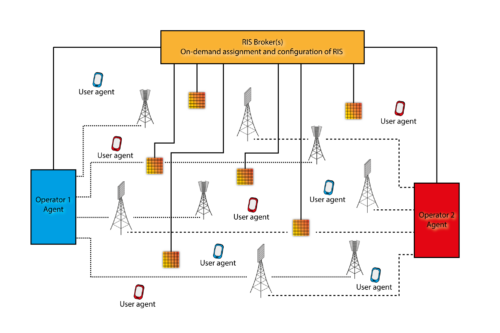
This project investigates how reconfigurable intelligent surfaces can be assigned and coordinated across multiple operators and users in a fair, energy-efficient, and scalable manner. The project adopts a social welfare perspective, aiming to satisfy user quality-of-service requirements while minimizing the overall energy consumption of the wireless system. To achieve this, the project develops learning-based coordination and decision-making methods that enable dynamic and sustainable operation of future wireless networks.
Research questions and objectives
The project addresses the following central research questions:
-
How can broadband reconfigurable intelligent surfaces be modeled realistically and efficiently for large-scale wireless networks?
-
How can multiple network operators share and coordinate reconfigurable intelligent surfaces while balancing competition and cooperation?
-
How can learning-based methods adapt to dynamic user demands, mobility, and network conditions with limited computational and information exchange?
To answer these questions, the project pursues three main objectives:
-
Modeling broadband reconfigurable intelligent surfaces
Develop tractable yet realistic models that capture the frequency-selective and directional behavior of reconfigurable intelligent surfaces, enabling large-scale system analysis and optimization. -
Learning-based assignment across operators
Design distributed reinforcement learning methods that allow network operators to dynamically assign reconfigurable intelligent surfaces in a way that meets user requirements while minimizing energy consumption and supporting fair coexistence. -
Learning-based coordination across users
Develop reinforcement learning techniques that coordinate how assigned reconfigurable intelligent surfaces support multiple users, accounting for diverse quality-of-service requirements such as throughput, reliability, latency, and energy efficiency.
Expected novelty and results
The project introduces a new system-level perspective on reconfigurable intelligent surfaces by treating them as shared infrastructure in multi-operator wireless networks. Instead of optimizing individual surfaces in isolation, the project focuses on coordination, assignment, and learning at network scale.
Key expected outcomes include:
-
New models for broadband reconfigurable intelligent surfaces suitable for large-scale optimization.
-
Distributed reinforcement learning frameworks for coordinated decision-making across operators and users.
-
Energy-efficient strategies that improve network performance while supporting sustainable operation.
-
Conceptual foundations applicable beyond wireless communications, including other shared and competitive resource systems.
Overall, the project aims to enable fair, adaptive, and energy-efficient use of reconfigurable intelligent surfaces, paving the way for sustainable next-generation wireless networks.